
Take Steps to Minimize the Risk of Food Tampering
There is a possibility that food might be used as a vehicle for the spread of biological or chemical agents as part of a terrorist attack.
As a food establishment operator, there are some steps you can take to reduce the risk that foods you serve contribute to the spread of foodborne hazards.
Become Informed
The United States Food and Drug Administration has published extensive guidance information for the food industry. This guidance includes precautionary and emergency response measures for producers, processors, transporters and retailers. This guidance
and links to other important information regarding food safety and bioterrorism can be found at www.foodsafety.gov or call 1-888-SAFEFOOD
An official website of New York State.
At the Back Door
Know your suppliers and your products
•Purchase products only from reputable, established sources.
•Maintain purchase records with product identification codes whenever possible.
•Inspect deliveries carefully for signs of tampering or unusual physical characteristics. Knowing what is normal will improve detection of suspicious items.
•Contact suppliers if you have concerns about the appearance of a product or package. There may be an explanation.
•Bring all deliveries inside establishment or otherwise secure them to prevent tampering.
•Restrict access to unloading and storage areas. Operations with many employees should consider ID badges coded to identify work areas.
•Keep all exterior storage areas locked when not directly supervised.
In the Kitchen
Know your employees
•Require complete applications and check references. Conduct background checks as allowed by law.
•Restrict access to food preparation areas to authorized personnel.
•Investigate and/or report suspicious activity.
•Have an employee sick leave policy that encourages employees to report illness and to not report to work when they are ill with gastrointestinal symptoms or other communicable illnesses.
•Restrict personal items allowed in food preparation and storage areas. Prevent workers from bringing lunch containers and purses into food handling areas.
Before preparation
•Inspect stored food products for signs of tampering prior to preparation or service.
•Make sure any water source meets all NYS drinking water standards and is adequately protected.
•Thoroughly rinse all produce with drinking-quality water prior to preparation or service.
Salad Bar/Buffet Areas
Customer self-service areas should be considered areas of high risk
•Monitor self-service areas at all times.
•Minimize quantity of food on display. Discard remaining product that has been out for self-service.
•Whenever possible avoid mixing new product with foods already on display.
•Train all employees to be alert for suspicious activity and to report it to supervisors immediately.
Responding to an Incident
Be prepared to assist local officials in investigating the source of a foodborne illness.
•Post 24-hour contact information for local, state and federal police/fire/rescue/government agencies near the telephone.
•Identify management personnel that employees should alert about potential security problems.
Food tampering is a crime. Do not handle or disturb products known or suspected to have been tampered with. Clear people
from the area and notify law enforcement authorities, then your local health department.
New York State Sanitary Code Part 14 requires all food service operators to report the occurrence or allegations of foodborne
illness. Report within 24 hours by telephone or in person to the permit-issuing official.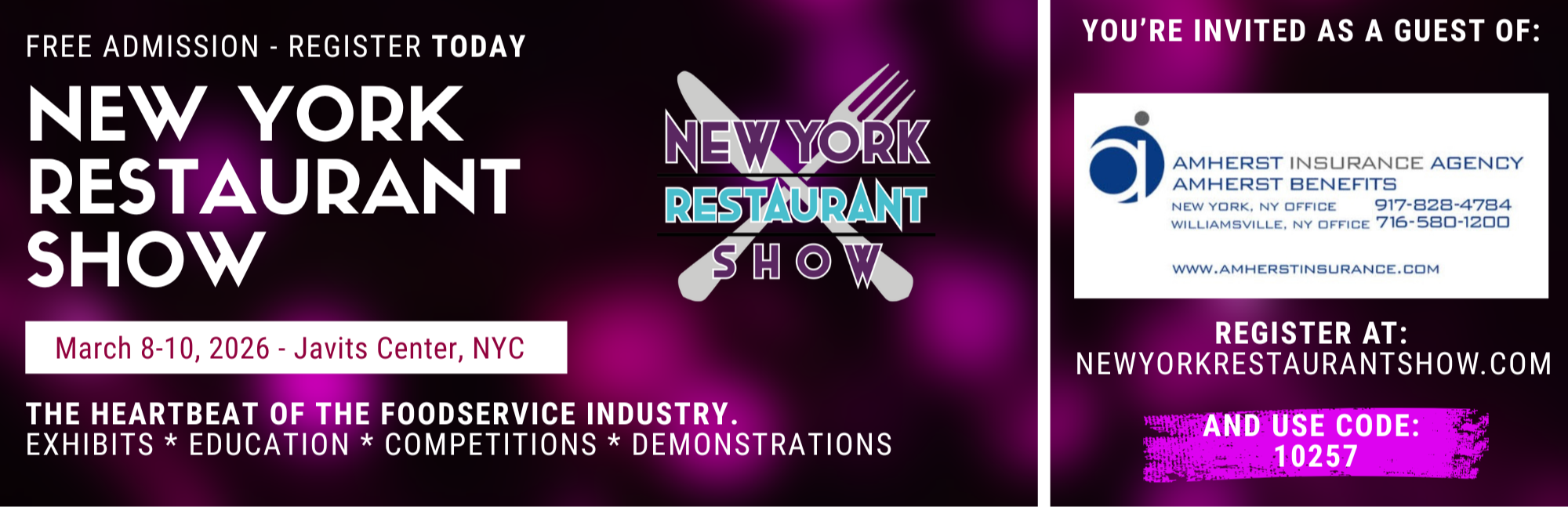
Amherst Insurance will be at the NYSRA Show at The Jacob Javits Center March 8-10. Please use attached ticket and register today for free admission. We will be located at Booth 1858 adjacent to the New York City Hospitality Alliance stage. See you at the NYSRA Show!